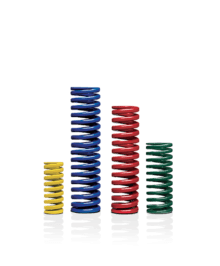
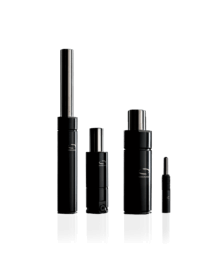
In almost all stamping dies, a large number of elastic components, springs, are used. Among these elastic components, there are various types of elastic standard parts, acrylic, nitrogen gas springs, etc. Different elastic components are selected according to different requirements. For instance, for bending and punching, common rectangular elastic components are sufficient. For instance, in terms of color, brown springs can also be called coffee-colored springs. If the elasticity is insufficient, add a nitrogen gas spring instead. However, nitrogen gas springs are relatively expensive, so the mold cost is a bit higher. Among them, there is also an elastic component called Youli glue. This kind of elastic component is very cheap, but the service life of the spring is relatively short. This is generally used for deep drawing dies, shaping dies, or for flatness adjustment.
The effect of using acrylic glue for deep drawing dies is quite good. Of course, nitrogen gas springs can also be selected. Others such as top material pins, float blocks, and dual-purpose pins generally use wire springs or yellow springs, etc. As long as they can remove the material without leaving marks or deforming the product, it is fine. The feature of Youli glue is its relatively balanced elasticity. However, due to its relatively short service life, it may crack after a short period of application. Therefore, it is generally used less frequently. For flatness, Youli glue is more commonly used.
Springs include rectangular springs, wire springs, etc. The purpose of springs is to release and press the material. The magnitude of the spring force is related to whether the mold production is smooth and whether the products produced are qualified. When the elastic force of the spring is weakened, it is very likely to cause various problems such as the product deforming due to the inability to hold down the material, the mold not detach the material, the product being difficult to remove from the mold, material being carried, and simple wear of the cutting edge and punch.
Rectangular springs are generally classified by their color into: brown, green, red, blue and yellow. Their elastic force also weakens accordingly. Depending on the color, the elastic force varies, and so does the compression amount.
Here is a folk method to calculate the compression of a spring: First, we measure the total height of the spring. Then, place the spring in a vise and lock it. Next, use a caliper to measure the remaining length of the spring after it is clamped. Subtract this number from the total length of the spring and then divide by the total length. This method is applicable to any spring. To give a simple example, if the length of a brown spring is 60mm, After being clamped by the vise, there should still be about 45.6 left. Then we subtract 45.6 from 60 to get 14.4, and divide 14.4 by 60. The result is 0.24, and this is its compression amount.
Depending on the number of times the spring is used, such as 1 million times, 500,000 times, or 300,000 times, the larger the compression amount selected, the shorter the service life of the spring, and the shorter the service life of the mold (of course, if the spring is broken, it can be replaced). After a period of time, the mold may cause the spring to break or even lose force. Springs of poor quality are very likely to break inside the mold.
Generally, the compression amount of the spring is calculated based on 300,000 cycles. That is to say, after the mold is pressed 300,000 times, the spring may run out of force. Of course, the service life of general stamping dies is not that long and can also be calculated based on the maximum compression amount. If calculated based on the maximum compression amount, it can only ensure that the spring does not burst inside the mold. Pressing the mold a little tighter is also beneficial for the flatness of the product.
The maximum compression amount (how much this spring can be compressed), the maximum compression amount of the spring is equal to the original height of the spring X the maximum compression ratio of the spring. For example, for a brown spring with a length of 60mm, its maximum compression amount is: 60*24% is approximately equal to 14. This spring can be pressed down by a maximum of 14 millimeters, and its maximum stroke is 14 millimeters. The stroke of the die must be less than 14 millimeters. If it exceeds 14 millimeters, the spring may fail, deform, break inside the die, or the die may burst, preventing the press from pressing down, etc.
Before the mold is assembled, that is, before the mold is installed, it is necessary to first calculate whether the compression amount of the spring is appropriate. Only in this way can there be no need to worry about problems with the mold or it bursting during the mold trial.